
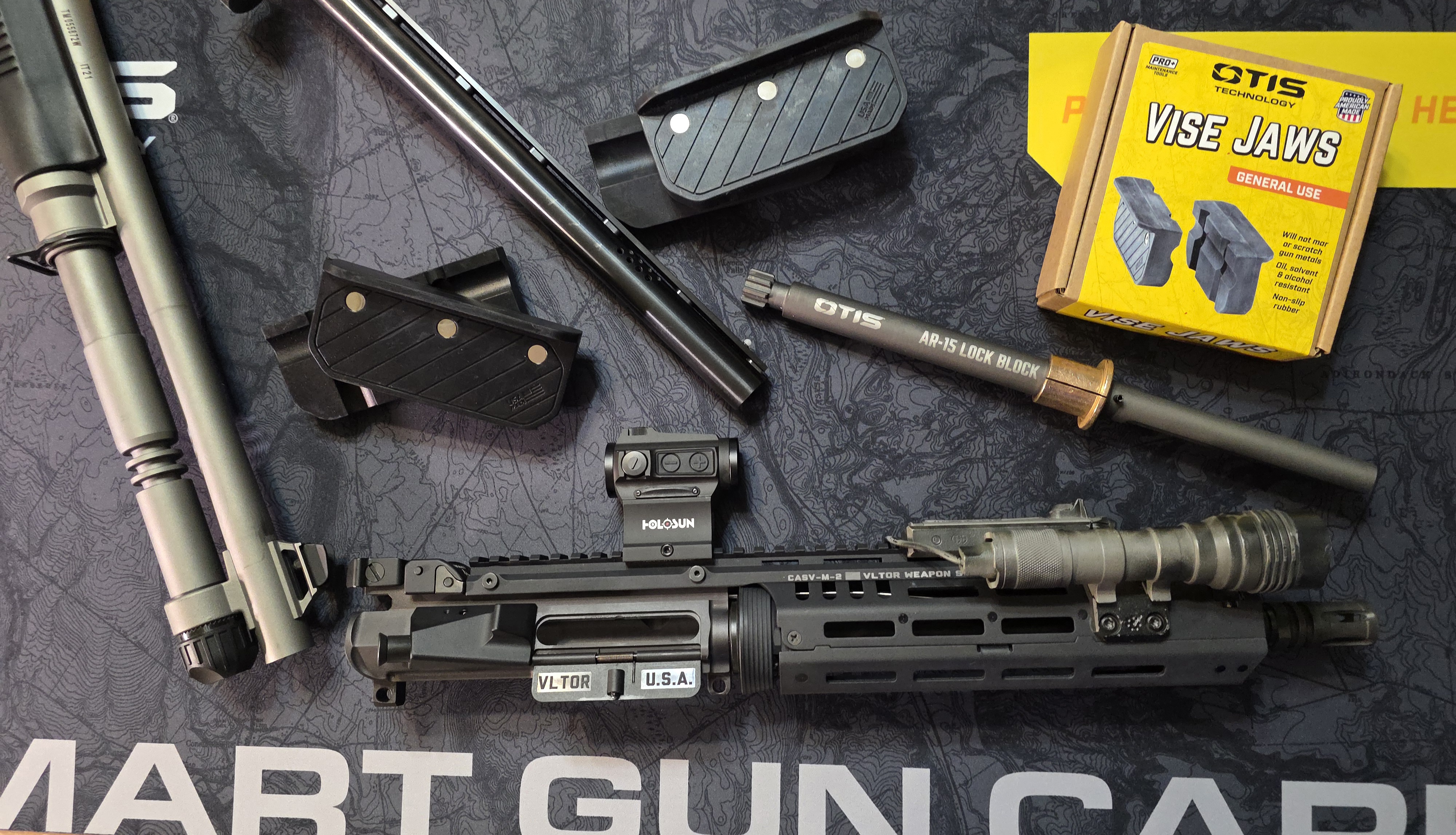
I felt like I needed to up the tool game and be more capable as a home “gunsmif.”
To this point I already had vises, barrel nut wrenches, torque wrenches, Allen keys, punches, hammers, magwell blocks, and the rest of the usual pile. What I did not have was a pair of proper vise jaws or an action rod.
Through Brownells I grabbed an Otis PRO+ AR-15 Lock Block, the Otis General Use vise jaws, and one of the last sets of the now-discontinued Otis Remington 1100 vise jaws. The plan was simple: tinker on black rifles and shotguns without chewing up finishes or chasing parts around the bench.
I’ve been using Otis on ARs for 15-plus years. Cleaning kits, the B.O.N.E. tool, and CLP have stayed at the top of the list. This was the first time I put any of their gunsmithing tools on the vise.

Lock Block first: VLTOR 10.5″ CAS-V and M-Lok T-nuts
First up was the VLTOR 10.5″ CAS-V build. I needed to install an old Streamlight and a Cloud tapeswitch mount.
The Lock Block will handle muzzle devices and heavier assembly work. That is what it is built for — lugs into the barrel extension so torque goes into steel instead of the aluminum upper. I just don’t use it that way as often as I use it as a fixture.

M-Lok T-nuts are still my least favorite mounting hardware. Being able to snug the Lock Block in the vise, then rotate the entire upper to whatever angle the slot needs, turns that job into a non-event. The rail stays put. Both hands stay on the mount and the nut. No more rolling a complete upper across a towel while a T-nut spins in the slot.
If you already own a decent vise, this is the piece that makes accessory work feel like you have a third hand.

Soft jaws: magnets first, then the channels
Then I put the jaw sets on.
Both the general set and the 1100 set have three magnets that hold the inserts on the vise jaws before you close anything. That matters more than it sounds. On a full-size bench vise or a mini clamp-on vise — which is what I had on the bench that day — the jaws stay put until you are ready to tighten. You are not pinching rubber with one hand and a barrel with the other.
The General Use set has a flat face plus barrel channels at .625″ and .750″. Receivers, slides, and common rifle barrels all have a place to sit.
The Remington 1100 set is cut for a standard 12-gauge barrel with a top-rib pocket. That extra notch is the whole product. It puts even pressure on the tube and the rib so you are not fighting the barrel’s potential rotation to pop a choke.

Shotgun barrels: Mossberg first, then the M4
I am a shotgun junky, so the 1100 jaws went on a neglected Mossberg 12-gauge barrel. Goal was simple: pull the choke and inspect the bore.

The 1100-pattern jaws fit that barrel the way they are supposed to. The rib dropped into the cutout and the whole tube sat still. No rolling, no extra hand on the barrel while the wrench came off the choke.
Then I wanted the tacti-cool version. I pulled the barrel off the Benelli M4 and tried the same jaws.

It worked. Not as locked-in as the Mossberg — there is no top rib, so a stubborn choke can still get a little rotation — but well enough to hold the tube for cleaning and choke work. The rubber still grabs a round 12-gauge barrel. The rib pocket just isn’t doing anything.
If I feel like it later, I can cut an extra notch in the rubber for the front ghost-ring base on an M4 or a Beretta 1301 Tactical and lock that barrel in completely. I may do that. For now, “worked fine” is the honest review.

The Lock Block is not just a barrel-nut tool. On this bench it earns its space holding uppers while M-Lok hardware goes on.
The general jaws are the pair that will see the most mixed use.
The 1100 set is discontinued, which is why I grabbed one of the last ones. On a ribbed 12-gauge barrel it is exactly what it claims to be. On an M4 it is a round-barrel clamp with a leftover pocket — usable, not perfect, and easy to admit in a sentence.
Shotguns are niche. I understand why a Remington 1100-specific jaw set got dropped. I still hope Otis takes another swing at a shotgun-oriented set: keep the top-rib cut, and add a notch that locks a barrel-mounted ghost-ring front sight the way an M4 or a 1301 Tactical actually sits. Tactical shotguns have enough of a market now that a broader 12-gauge jaw design is not a crazy ask.
None of this replaces a good vise. It keeps the vise from becoming the thing that marks up the gun.
Full disclosure:
I am a Brownells affiliate. These Otis Technology products are available at Brownells here (affiliate link; I may receive a modest commission). You can also use my affiliate discount code FRIED10 for 10% off orders of $150 or more.

Leave a Reply